Love Offerings Fresh Content

Thursday

How to Customize Your Avon E-Store

How to Customize Your Avon E-Store

1. Login To YourAvon.com
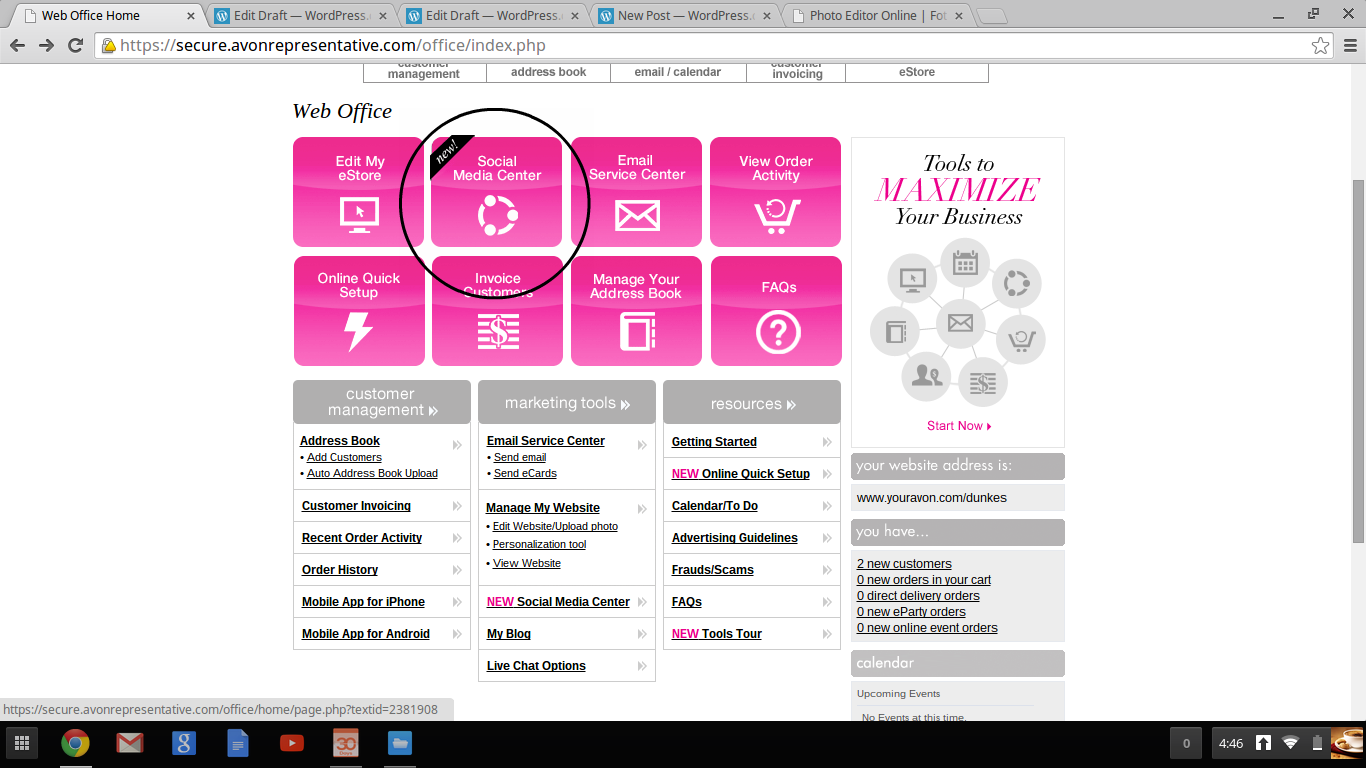
2. Click on Your Web Office Tab – Here you can view your e-store address, all your new customers, and your direct delivery orders.  Screenshot use 1
3. Make sure all your information is correct – You can do this by clicking edit my e-store and editing the areas with a edit box next to it or you may click quick set up.
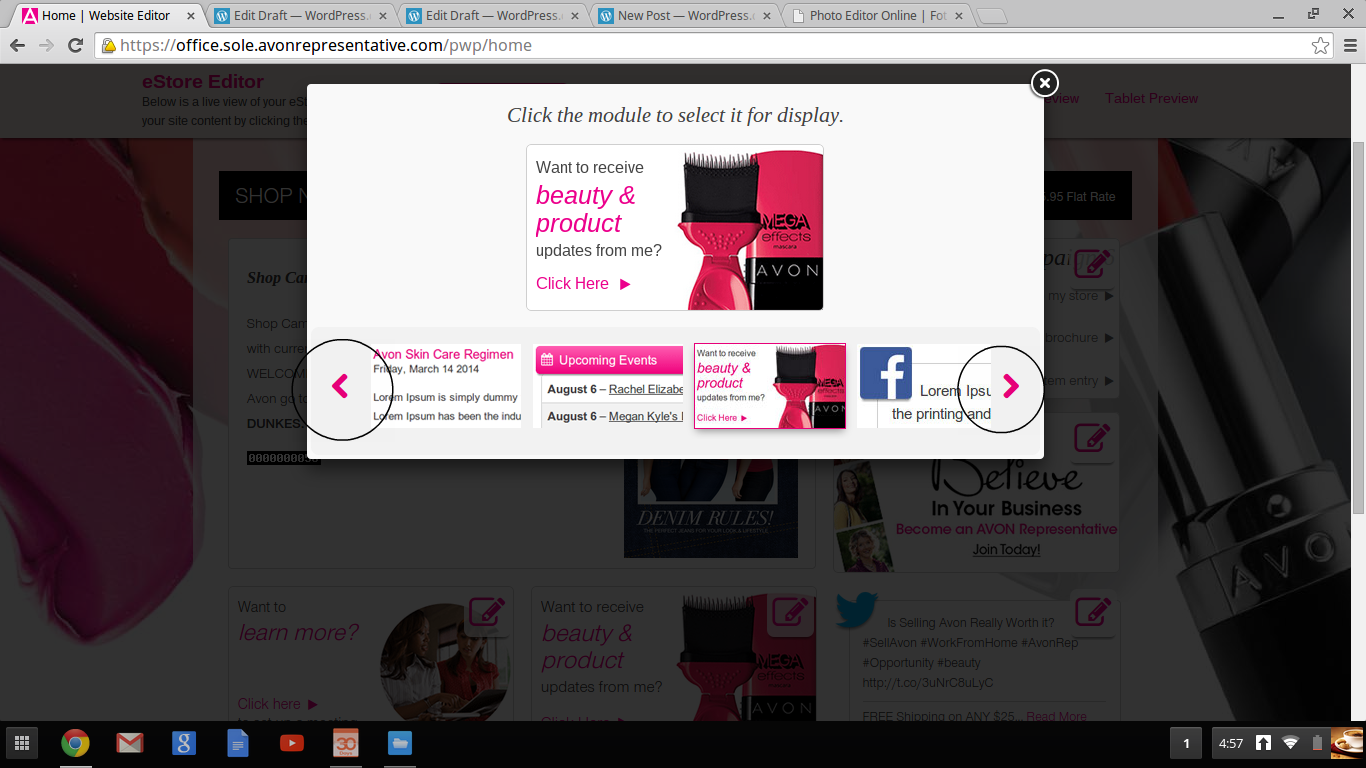
Screenshot use 24. Click Edit my E-store – Now you can click edit Your e-store! Click on the edit box then use the arrows to browse through the options until you find the option you desire.(Again, I make the opportunity, registering for e-mail updates, and browsing the current brochure the main options I want people to view)
use1use2


Making your online website easier to navigate should increase your number of orders based on your number of views! Also, Don’t forget that you can use your Social Media Center to share post directly to all your social media sites with the click of a button.

Sunday

11 Smart Ways to Grow Your Online Business to a New Level

As mobile technology continues to dominate the Internet, online businesses are expected to thrive over the next few years. eMarketer estimates e-commerce sales will continue to average an annual growth rate of 10% until 2018 at the near term. By then global sales for online businesses would hit US$2.356 Trillion or an average of US$200 Billion new sales every year beginning 2014.

This optimistic growth forecast means the online business industry still presents opportunities for new players. As with all ventures, starting an online business will present challenges. But once you gain traction, business should move smoothly. The next challenge is taking your online business to the next level.

Here are 11 smart ways to consider for growing your online business:

1. Update your market research

Because information is readily accessible and available on the Internet, demand, tastes and consumer preferences are unpredictable and unstable. What is in vogue today could be passé tomorrow. The latest technological breakthrough could be obsolete in a few weeks.

Thus, it is very important for you to continually update your market research. Your target market could be undergoing changes in its demographic profile. And its consumption and behavioral patterns could be changing. Their concerns which you addressed when you launched your online business may no longer be valid.

2. Focus on high quality content marketing

Once you’ve firmed up your market research, focus on delivering high quality content marketing to them. The keyword is to personalize content. You materials must speak directly to your audience and provide actionable solutions to their concerns.

Your content must unequivocally state “Why” your online business is the best solution or only option to consider.

Content marketing is not only blogs and articles. You can use other media such as videos and podcasts. Video is an effective vehicle for delivering content as it can capture attention faster than blogs or still images.

3. Target realistic goals

Goal setting is an effective strategy for improving performance. It charts the course to where you want your business to go. But these goals must be realistic. If your online business generated $100,000 in annual revenues, it would not be realistic to identify next year’s revenue targets at $1,000,000.

Your goals must correspond with your ability to scale operations. You must consider sources of funding: internal cash flow generation, borrowings and current state of liquidity. You are also faced with the prospects of an ever-changing market. These should put your growth targets in their proper perspective.

Set small targets that are within your current capacity. For example, target a 10% increase in revenues. Then determine the corresponding adjustments to market acquisition, leads generation and sales conversion that will support this sales target.

4. Improve customer experience

Creating markets is one thing, retaining markets is another thing. Given the increase in competition, businesses are allocating more resources to market retention. You simply would not want your competition to capture your customer. In fact, customer service is already passé. The focus is now customer experience.

Customers will continue to patronize your product and service if they feel you genuinely care about their experience. You can do this a number of ways:

Increase the number of contact points to your e-commerce website. In addition to e-mail and phone, add chat support services and actively engage with customers in social media.Hire virtual assistants to run outbound services. This includes surveys conducted via phone or e-mail. According to OutsourceWorkers, hiring virtual assistants is 3 times more cost effective than regular full time employees.Establish a quick Turn Around Time or TAT on all queries and concerns. 24 hours or less is the gold standard in customer experience.5. Be active on social media

As an online business, your primary medium is the Internet. Your business should be highly visible in the virtual world. One of the best strategies is to be active on social media.

Of the more than three billion Internet users, two billion are on social media. As of its latest count, Facebook has 1.374 Billion daily users. That is more than half of the daily Internet population! eMarketer projects the number of social media users will increase to 2.55 Billion daily by 2017.

If these numbers are convincing, then you should begin to prioritize social media as an online marketing tool.

The first step is to identify the social media network for your business. Each social network houses a distinct community with diverse online behavioral patterns. Facebook is more informal. LinkedIn has a professional approach. Twitter works best with high activity.

Why You Will Quit Your Job This Year


 This week, I read an intriguing post by Daniel Gulati on the Harvard Business Review Blog Network on Why You Won’t Quit Your Job.  Mr. Gulati does an excellent job articulating why people don’t make big changes in their lives and careers, and why most people will not, in fact, leave their jobs even though they desperately want to.
To summarize his points, the reasons you stay in a job or career you don’t like are:
You’ve been conditioned to stay
The famed psychologist B.F. Skinner proved that being rewarded at random intervals (rather than on a fixed schedule) is a highly effective way to reinforce behavior.   Our corporate employers do a wonderful job of keeping us coming back for more in our current roles, tightly weaving us into the fabric of the organization by giving us little random rewards (a boss’ praise, a new plum client, an exciting new project, etc.)
You’re risk averse, now more than ever
We all know humans are risk-averse.  Now, however, with online social networks and digital technology on the rise, your movements are far more visible.  You fear looking bad in front of thousands of people if it doesn’t work out, so you stay put.
You don’t reach for the highest peak because you’re focused on scaling smaller ones
Finally, Mr. Gulati points out that a majority of professionals are focused on “winning” the prize in front of them (such as the next promotion or raise).  They choose to scale the smaller peaks that emerge before them, rather than choosing a different terrain entirely and starting at the bottom of a new, higher mountain that may be much more satisfying and lucrative.
I agree 100% that these factors and behaviors inhibit our movement and growth.  However, I believe this – these are all still excuses.  Another way to look at these inhibitors to change is to see them as core fears such as: 1) I’m afraid to give up the small rewards I have for the ultimate ones I want – fulfillment and success; 2) I’m afraid of failing and being seen as a big loser; and 3) I’m afraid to stretch myself to the highest degree possible because it’s hard.
Yes, most people are afraid and resistant to make significant life or career change.  But many still get over themselves, overcome their conditioning and push through.  As the slogan says, They “just do it.”  I for one did it — underwent two career transformations, from miserable corporate VP to marriage and family therapist, and then from therapist to career and executive coach and consultant.   And I’m so grateful I did.  The majority of professionals I coach and train each year (numbering in the thousands) are changing jobs or careers too, with great success.
Why do these people quit their jobs or change careers, and why will YOU?
Here are what I’ve found to be the top five reasons why professionals finally bite the bullet and make job or career change:
You’ve simply had it with what you have and what you’ve created
You wake up one day and realize, “I absolutely don’t want this anymore.  I’m clear, and I’m done.”  There’s enough pain, discomfort, meaninglessness or disconnection in your work that you simply can’t continue this way one more minute.  The small, random rewards you’ve been receiving over the years just don’t cut it anymore. You’re not seduced by them any longer.
2) You have the confidence and courage to do it
You’re smart and savvy.  You’ve done your research about what’s involved to successfully change jobs or careers, and understand what it takes.  You realize that, while your self-esteem has been rocked a good deal throughout these past years in this job, you still have enough confidence and grit to do what’s necessary.

3) Your eyes are wide open
You’ve learned an enormous amount throughout your jobs and the arch of your career.  You’ve seen that it’s not just your job that’s making you miserable, but it’s YOU in your job that you want to change.  You realize that getting on the path to making career or job change is exactly what’s required if you want to have a new kind of life.
4) You have the support you need
You know you can’t make this change alone.  You need outside help that offers an empowered perspective of you, your talents, skills and passions.  You know you need the support of key friends and family as well as those who will keep you accountable, and you have it.
5) You know there’s something more to this life, and that you deserve it
Finally, you know that this unhappy job (and simply paying the bills each month without any joy or fulfillment in your work) is not all there is to life.  There IS more, and you’re hungry for it.  The bell has been rung.  Further, you know that you deserve it, because you understand that everyone deserves a fulfilling, joyful and successful life and career.  You will get it because you will design it that way, from this day forward.

Will you be one of those who stays in your miserable career or job, or will you decide that this is the year you will finally do something about it, and leave?

I’m betting on the latter.

What Interviewers Wish They Could Tell Every Job Candidate


In the best interviews, job candidates say a lot and interviewers very little – after all, the interview is about the candidate, not the interviewer.
But there are a few things interviewers would like to tell job candidates well before the interview starts.
1. I want you to be likeable.
Obvious? Sure, but also critical. I want to work with people I like and who in turn like me.
So: I want you to smile. I want you to make eye contact, sit forward in your chair, and be enthusiastic. The employer-employee relationship truly is a relationship -- and that relationship starts with the interview (if not before.)
A candidate who makes a great first impression and sparks a real connection instantly becomes a big fish in a very small short-list pond. You may have solid qualifications, but if I don't think I'll enjoy working with you, I'm probably not going to hire you.
Life is too short.
2. I don’t want you to immediately say you want the job.
Oh, I do want you to want the job -- but not before you really know what the job entails. I may need you to work 60-hour weeks, or travel 80% of the time, or report to someone with less experience than you... so sit tight for a bit.
No matter how much research you've done, you can't know you want the job until you know everything possible about the job.
3. I want you to stand out....
A sad truth of interviewing is that later I often don't recall, unless I refer to my notes, a significant amount about some of the candidates. (Unfair? Sure. Reality? Absolutely.)
The more people I interview for a job and the more spread out those interviews, the more likely I am to remember a candidate by impressions rather than by a long list of facts.
So when I meet with staff to discuss potential candidates I might initially refer to someone as, "the guy with the bizarre stainless steel briefcase," or "the woman who does triathlons," or "the gentleman who grew up in Lichtenstein."
In short, I may remember you by "hooks" – whether flattering or unflattering – so use that to your advantage. Your hook could be your clothing, or an outside interest, or an unusual fact about your upbringing or career. Better yet your hook could be the project you pulled off in half the expected time or the huge sale you made.
Instead of letting me choose, give me one or two notable ways to remember you.
4. ... but not for being negative.
There's no way I can remember everything you say. But I will remember sound bites, especially the negative ones – like the candidates who complain, without prompting, about their current employer, their coworkers, or their customers.
So if for example you hate being micro-managed, instead say you're eager to earn more responsibility and authority. I get there are reasons you want a new job but I want to hear why you want my job instead of why you're desperate to escape your old job.
And keep in mind I'm well aware our interview is like a first date. I know I'm getting the best possible version of "you." So if you whine and complain and grumble now... I know you'll be a real treat to be around in a few months.
5. I want you to ask lots of questions about what really matters to you...
I need to know whether I should hire you, but just as importantly I need you to make sure my job is a good fit for you.
So I want you to ask lots of questions: What I expect you to accomplish early on, what attributes make our top performers outstanding, what you can do to truly drive results, how you'll be evaluated… all the things that matter to you and to me and my business.
You know what makes work meaningful and enjoyable to you. I don't. There's no other way to really know whether you want the job unless you ask questions.
6. ... but only if the majority of those questions relate to real work.
I know you want a positive work-life balance. Still, save all those questions about vacation sign-up policies and whether it's okay to take an extra half hour at lunch every day if you also stay a half hour late and whether I've considered setting up an in-house childcare facility because that would be really awesome for you and your family.
First let's find out if you're the right person for the job, and whether the tasks, responsibilities, duties, etc. are right for you.
Then we can talk about the rest.
7. I love when you bring a "project."
I expect you to do a little research about my company. That’s a given.
To really impress me, use the research you’ve done to describe how you will hit the ground running and contribute right away – the bigger the impact the better. If you bring a specific skill, show how I can leverage that skill immediately.
Remember how I see it: I have to pay your salary starting day one, so I'd love to see an immediate return on that investment starting day one.

8. At the end I want you to ask for the job... and I want to know why.
By the end of the interview you should have a good sense of whether you want the job. If you need more information, say so and let's figure out how to get what you need to make a decision.
If you don't need more information, do what great salespeople do and ask for the job.
I'll like the fact you asked. I want you to really want the job -- but I also want to know why you want the job. So tell me why: You thrive in an unsupervised role, or you love working with multiple teams, or you like frequent travel.
Ask me for the job and prove to me, objectively, that it's a great fit for you.
9. I want you to follow up... especially if it's genuine.
Every interviewer appreciates a brief follow-up note. If nothing else, saying you enjoyed meeting me and are happy to answer any other questions is nice.
But "nice" may not separate you from the pack.
What I really like – and remember – is when you follow up based on something we discussed. Maybe we talked about data collection techniques and you send me information about a set of tools you strongly recommend. Maybe we talked about quality and you send me a process checklist you developed that I could adapt to use in my company. Or maybe we both like cycling, so you send me a photo of you on your bike in front of the sign at the top of the Col du Tourmalet (and I'm totally jealous.)
The more closely you listened during the interview, the easier it is to think of ways to follow up in a natural and unforced way.
Remember, we're starting a relationship -- and even the most professional of relationships are based on genuine interactions.

Top 10 Ways to Guarantee Your Best People Will Quit


Here are 10 ways to guarantee that your best people will quit:
10. Treat everyone equally. This may sound good, but your employees are not equal. Some are worth more because they produce more results. The key is not to treat them equally, it is to treat them all fairly.
9. Tolerate mediocrity. A-players don’t have to or want to play with a bunch of C-players.
8. Have dumb rules. I did not say have no rules, I said don’t have dumb rules. Great employees want to have guidelines and direction, but they don’t want to have rules that get in the way of doing their jobs or that conflict with the values the company says are important.
7. Don’t recognize outstanding performance and contributions. Remember Psychology 101 — Behavior you want repeated needs to be rewarded immediately.
6. Don’t have any fun at work. Where’s the written rule that says work has to be serious? If you find it, rip it to shreds and stomp on it because the notion that work cannot be fun is actually counterproductive. The workplace should be fun. Find ways to make work and/or the work environment more relaxed and fun and you will have happy employees who look forward to coming to work each day.
5. Don’t keep your people informed. You’ve got to communicate not only the good, but also the bad and the ugly. If you don’t tell them, the rumor mill will.
4. Micromanage. Tell them what you want done and how you want it done. Don’t tell them why it needs to be done and why their job is important. Don’t ask for their input on how it could be done better.
3. Don’t develop an employee retention strategy. Employee retention deserves your attention every day. Make a list of the people you don’t want to lose and, next to each name, write down what you are doing or will do to ensure that person stays engaged and on board.
2. Don’t do employee retention interviews. Wait until a great employee is walking out the door instead and conduct an exit interview to see what you could have done differently so they would not have gone out looking for another job.
1. Make your onboarding program an exercise in tedium. Employees are most impressionable during the first 60 days on the job. Every bit of information gathered during this time will either reinforce your new hire’s “buying decision” (to take the job) or lead to “Hire’s Remorse.”
The biggest cause of “Hire’s Remorse” is the dreaded Employee Orientation/Training Program. Most are poorly organized, inefficient, and boring. How can you expect excellence from your new hires if your orientation program is a sloppy amalgamation of tedious paperwork, boring policies and procedures, and hours of regulations and red tape?
To reinforce their buying decision, get key management involved on the first day and make sure your orientation delivers and reinforces these three messages repeatedly:
A. You were carefully chosen and we’re glad you’re here;
B. You’re now part of a great organization;
C. This is why your job is so important.